Building Leaders Who Stay Clear Under Pressure
Practical, neuroscience-informed keynotes and workshops that provide leaders with tools to stay clear, improve decision quality, accountability, and trust under pressure
Make clearer decisions under pressure without defaulting to reactivity, avoidance, or defenesiness
Set expectations and accountability skillfully and early, when it matters most
Learn to regulate one’s own internal state in order to positively influence the emotional climate of conversations and manage conflict
Vlad Moskovski is a Somatic Leadership practitioner, Executive Coach, and Organizational Development expert with over 15 years of experience working across startups and global organizations. He holds a Master’s degree in Organizational Development, is a former Accenture OD consultant and Stanford instructor, and has advised leaders and teams at organizations including Google, Meta, Roche, and numerous early-stage companies navigating high-change environments.






The Capacity Model
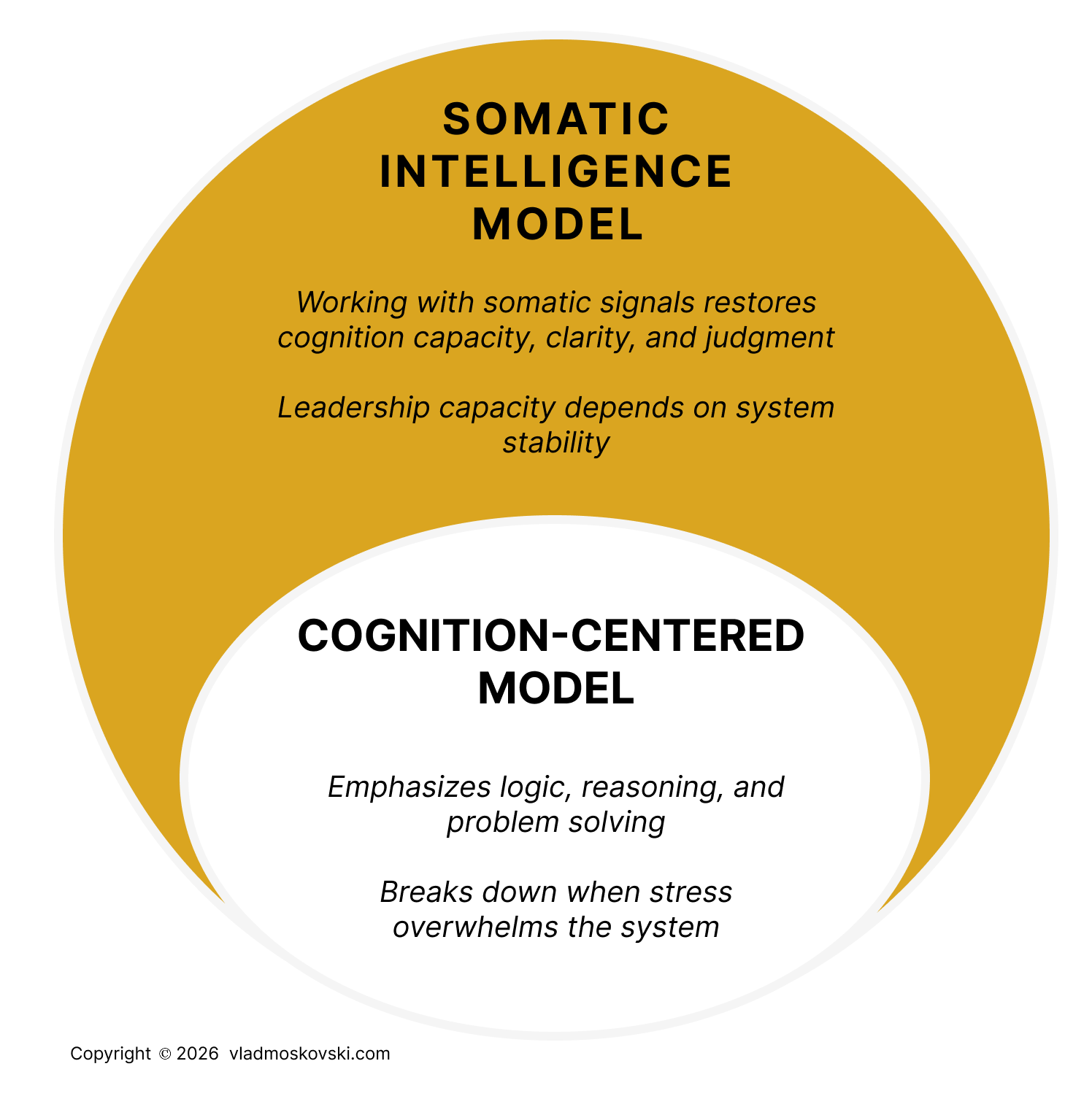
The three-part model below shows why Leadership Capacity, the ability to stay present, think clearly, and act deliberately, degrades under pressure and how to restore and expand that capacity by noticing and working with the body’s signals and senses.
Part 1: Two Components of Human Performance
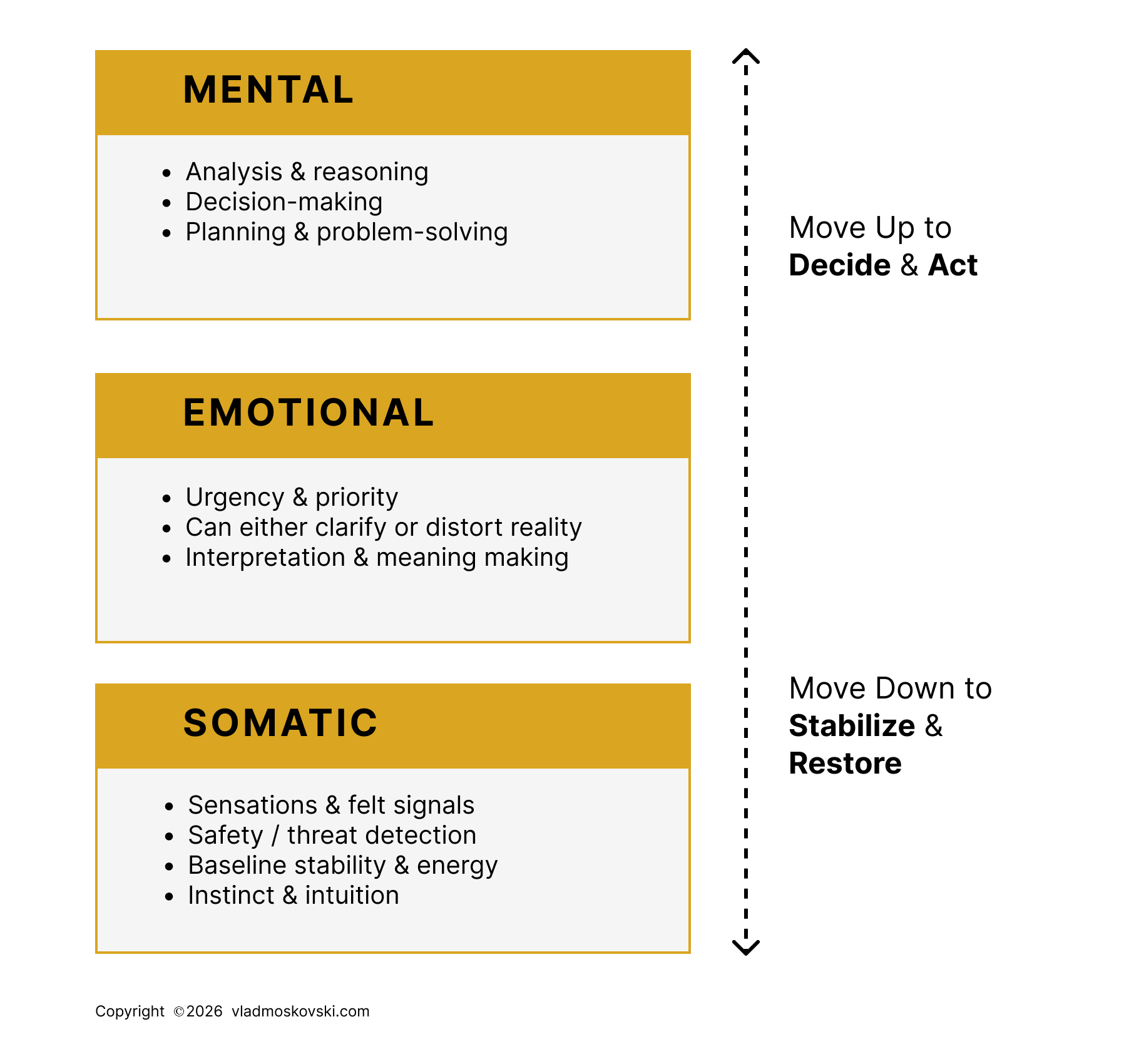
Part 2: Three Levels of Awareness
Under pressure, access to the mental layer degrades first. Capacity must be restored from the somatic layer.
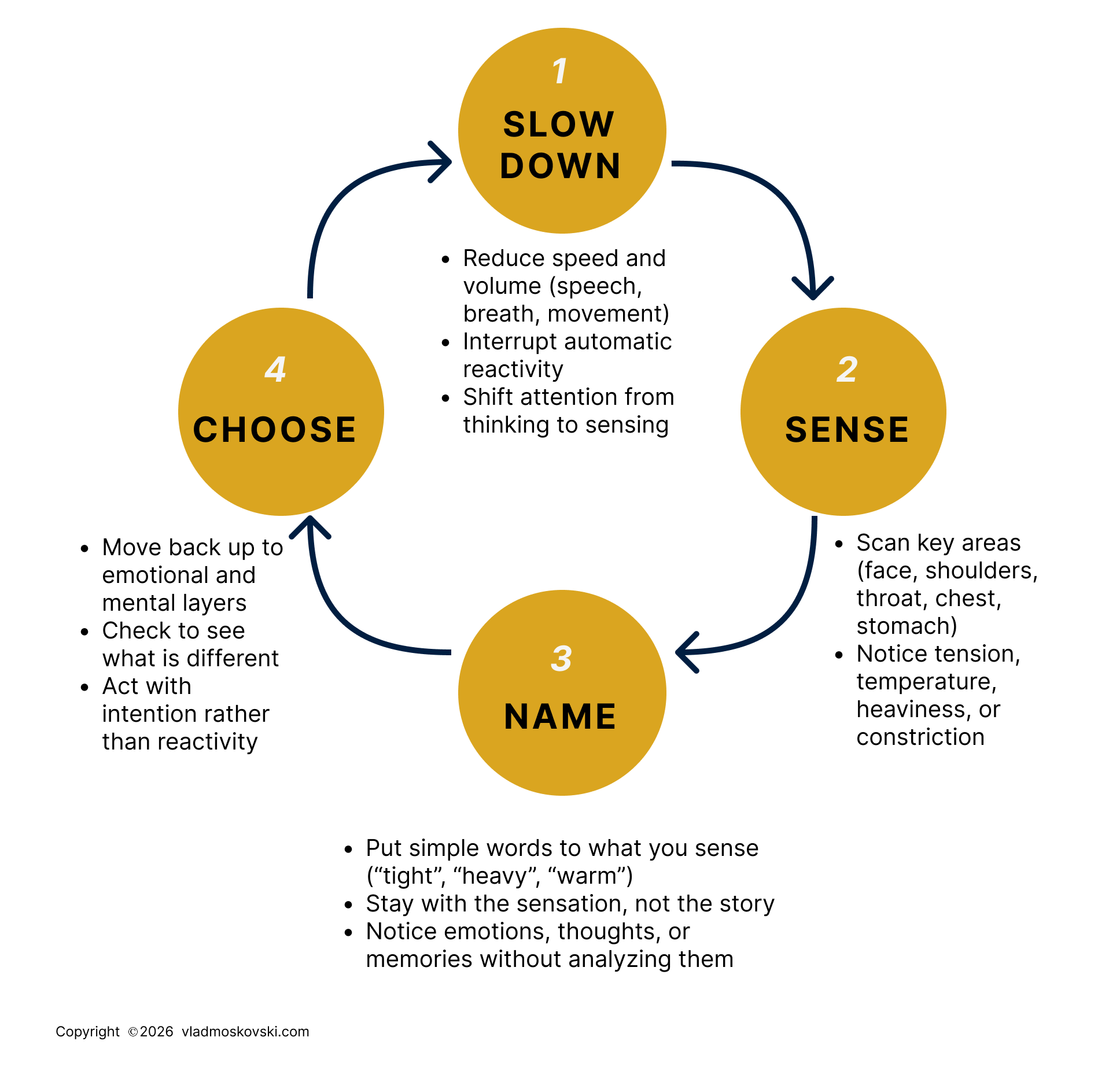
Part 3: The Somatic Wheel
A leader preparing for a high-stakes conversation notices rising anxiety. Using the framework below, they reset their system, engage thoughtfully, and clarify ambiguity before making key decisions.
The goal is not to calm down, it’s to restore capacity so better decisions become available.
Keynotes & Workshops
Nervous-System Savvy Managers
Most organizations train managers to “communicate better,” “stay calm,” or “be strategic,” yet continue to see overwhelm, conflict, and burnout. Why? Because you can’t think your way out of stress, you have to sense your way out. A manager’s nervous system is the most powerful (and overlooked) performance technology inside an organization.
This session reframes leadership development through a nervous-system-first lens, giving HR and L&D leaders a practical way to equip managers to navigate real-world pressure, interpersonal tension, and rapid change. Drawing on somatic intelligence, polyvagal theory, and case studies from fast-growing companies, participants will learn what actually happens in the body during modern work stressors, and how to help managers shift from reactivity to presence in under 60 seconds.
You’ll walk away with a simple somatic toolkit that can be embedded into coaching, manager training, onboarding, and leadership pathways. The result: leaders who regulate themselves effectively, co-regulate their teams, and reduce burnout and conflict.
Ideal for HR, People Ops, L&D leaders, and anyone responsible for manager effectiveness, culture health, and leadership development.
Outcomes:
You will have tools assess your current manager and leadership programs through a nervous-system lens, spotting where stress, overload, and dysregulation undermine learning and growth.
Participants will learn how to apply a practical Somatic Toolkit in their work: using 2–3 simple practices leaders can apply in 60 seconds (e.g., slow down → sense → name) in 1:1 conversations, trainings, and manager programs.
Practice nervous-system awareness on themselves: reliably noticing signs of regulation, dysregulation, or reactivity, and using a simple self-regulation routine before high-stakes decisions, conversations, or facilitation moments.
Format: Keynote or Workshop
From Overwhelm to Clear Decisions
Format: Workshop
Managers today are making more decisions than ever—often with less clarity, more uncertainty, and fewer in-person cues. The result: decision fatigue, conflict escalation, slow execution, and chronic overwhelm. Yet most leadership programs still rely on cognitive strategies (“pause and reflect,” “think rationally”) that simply don’t work when a manager’s nervous system is overloaded.
This session introduces a practical, somatic-first approach to decision-making in remote and hybrid environments. Grounded in polyvagal theory and somatic intelligence, participants will learn why overwhelm hijacks a manager’s ability to think clearly and how a simple nervous-system reset can shift leaders from reactivity into grounded, high-quality decision-making in under 60 seconds.
HR and L&D leaders will walk away with a structured somatic toolkit they can easily embed into coaching pathways, manager trainings, onboarding, and digital learning modules. These micro-practices help managers regulate under pressure, communicate with clarity, and navigate remote collaboration with more confidence and fewer misunderstandings.
This session is ideal for organizations looking to reduce burnout, accelerate execution, and equip managers with practical tools to perform at their best—especially in high-demand, distributed teams.
Outcomes:
Explain how overwhelm and dysregulation impair managerial decision-making, especially in remote and hybrid environments with high uncertainty and rapid context switching.
Teach managers a practical somatic decision-making protocol, using 2–3 micro-practices that shift leaders from reactivity to clarity in under a minute.
Integrate a Somatic Decision Toolkit into existing leadership programs, coaching sessions, onboarding, and digital learning modules to improve communication, collaboration, and execution.
Sovereign Accountability: Turning Unspoken Expectations into High-Trust Agreements
Format: Keynote or Workshop
In today’s hybrid, fast-moving workplaces, most performance breakdowns don’t come from “difficult people”, they come from expectations that were never clearly named, mutually owned, or realistically designed. This session introduces Sovereign Accountability, a practical leadership framework for turning vague assumptions and pressure-based “yeses” into clear, co-created design alliances that people actually keep. Leaders will learn concrete language, decision structures, and somatically informed micro-practices for setting expectations upfront and addressing missed agreements in ways that protect dignity, build trust, and reduce rework and conflict across teams.
Outcomes:
Equip leaders and managers to turn unspoken expectations into clear, high-trust agreements—so accountability is shared, humane, and actually sustained in day-to-day work.
Participants will:
Diagnose accountability breakdowns by identifying where vague expectations, implicit assumptions, and pressure-based commitments are quietly eroding trust and performance.
Apply the High-Trust Agreement Framework to co-create explicit, mutually owned expectations, using practical language structures to clarify scope, capacity, and success upfront.
Speaking Reel
Bring This Work to Your Organization
For keynote bookings, workshops, or internal leadership programs, use the inquiry form below. Share your event dates, audience size, and goals and I’ll be in touch to explore fit.