Why Nervous-System-Savvy Managers Excel Under Pressure
Christine had been avoiding giving feedback to her younger team member, Nancy, for weeks.
She had intercepted negative feedback from a client about Nancy’s work and knew, logically, that addressing it was essential for Nancy’s growth and the team’s success. Yet every time Christine considered initiating the conversation, her stomach tightened, and her jaw clenched. So she delayed. Again.
In the past, Christine would have ignored these sensations and pushed herself to “just have the conversation.” This time, she took a different approach. Instead of rehearsing talking points or forcing confidence, she brought her attention to the discomfort in her body. She noticed the knot in her stomach. The tension in her jaw. She stayed with those sensations without trying to fix or analyze them.
After a few minutes, the tightness began to soften. Her breathing slowed. Her body settled. And suddenly, clarity returned. Christine knew exactly how to frame the feedback. Firm, honest, and supportive.
The next afternoon, she and Nancy had a productive conversation that strengthened trust rather than eroding it. This is the power of somatic intelligence, creating change by working with the body’s signals rather than relying on prolonged mental analysis or willpower alone.
The Real Problem: Leadership Capacity Under Pressure
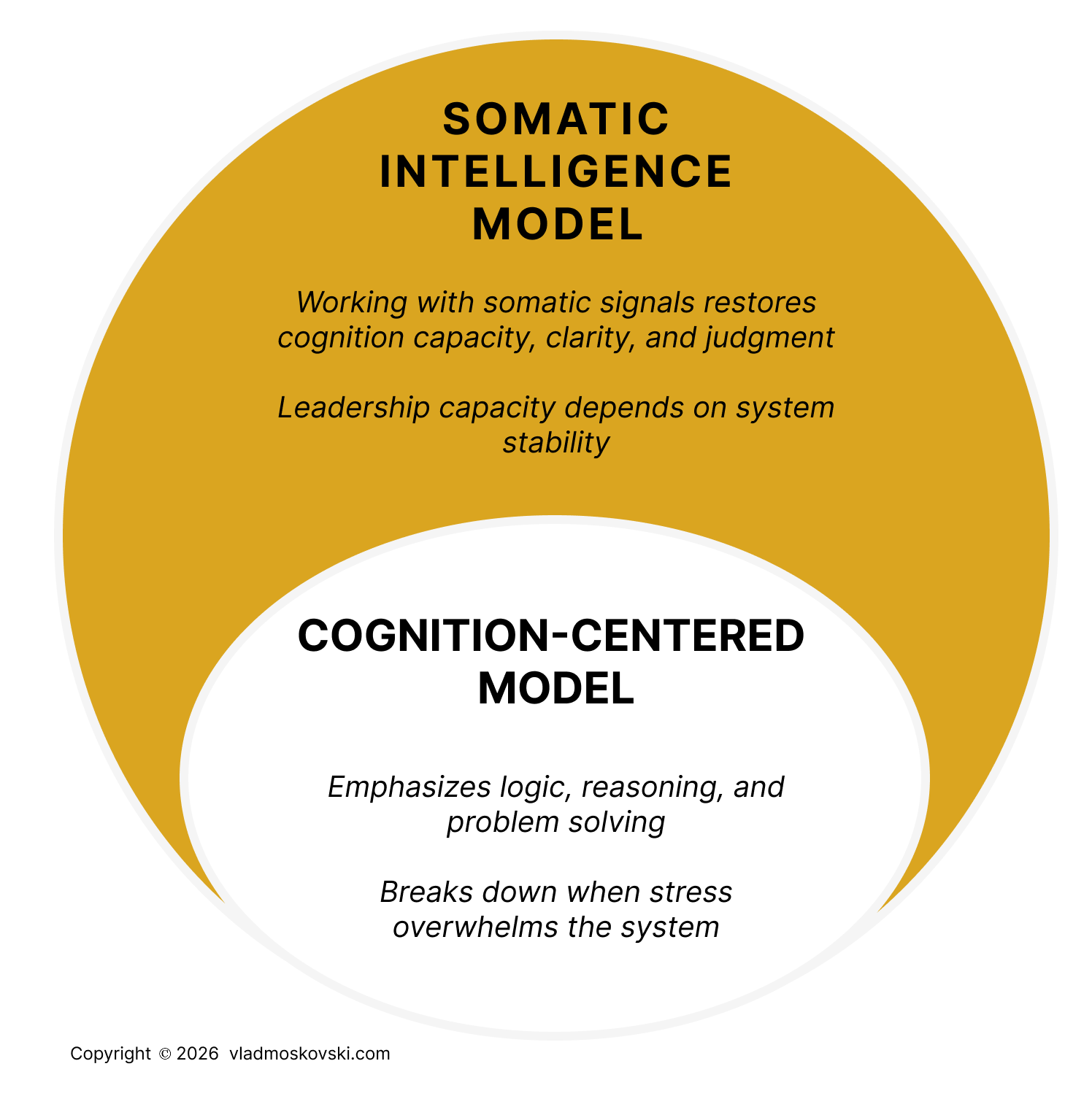
Most organizations train managers to “communicate better,” or “delegate efficiently,” yet continue to see overwhelm, conflict, and burnout. Why? Because you can’t think your way out of stress, you have to sense your way out. Leadership rarely breaks down because people lack insight, intelligence, or skill. It breaks down because pressure overwhelms capacity.
Leadership capacity is the ability to stay present, think clearly, and act deliberately. Under pressure, that capacity degrades. No amount of cognitive reframing or communication skill training can reliably compensate when the fundamental nervous system is overloaded.
This is not a mindset problem. It is a systems problem.
You Can’t Think Your Way Out of Stress
Under pressure, the human system can quickly become overwhelmed and go into a state of activation. As urgency rises, attention narrows. Emotions amplify meaning, and threats are amplified. The strategic and locigal brain becomes hijacked. Externally, this can look like avoidance, procrastination, reactivity, and overwhelm.
In these states, asking leaders to “communicate better,” “stay calm,” or “be strategic” is not only ineffective. It is misaligned with how human performance and the nervous system actually works. This is why capable, well-intentioned managers avoid difficult conversations, escalate conflict unnecessarily, freeze during decisions, or default to reactivity or over-control. The issue is a lack of access.
Somatic intelligence is the ability to notice and work with the body’s signals, thus granting an individual access to unhijack their own brain.
Rather than treating bodily sensations as noise or distraction, somatic intelligence treats them as early information about capacity, safety, and readiness. When leaders learn to work with these signals, the nervous system stabilizes. Cognitive clarity returns. Judgment and greater/better choices become available.
Somatic intelligence does not replace thinking. It restores the conditions and builds the capacity to function under pressure. This is why Christine did not need a new script or framework. Once her system settled, the right words emerged naturally.
From Insight to Practice: The Somatic Wheel Framework
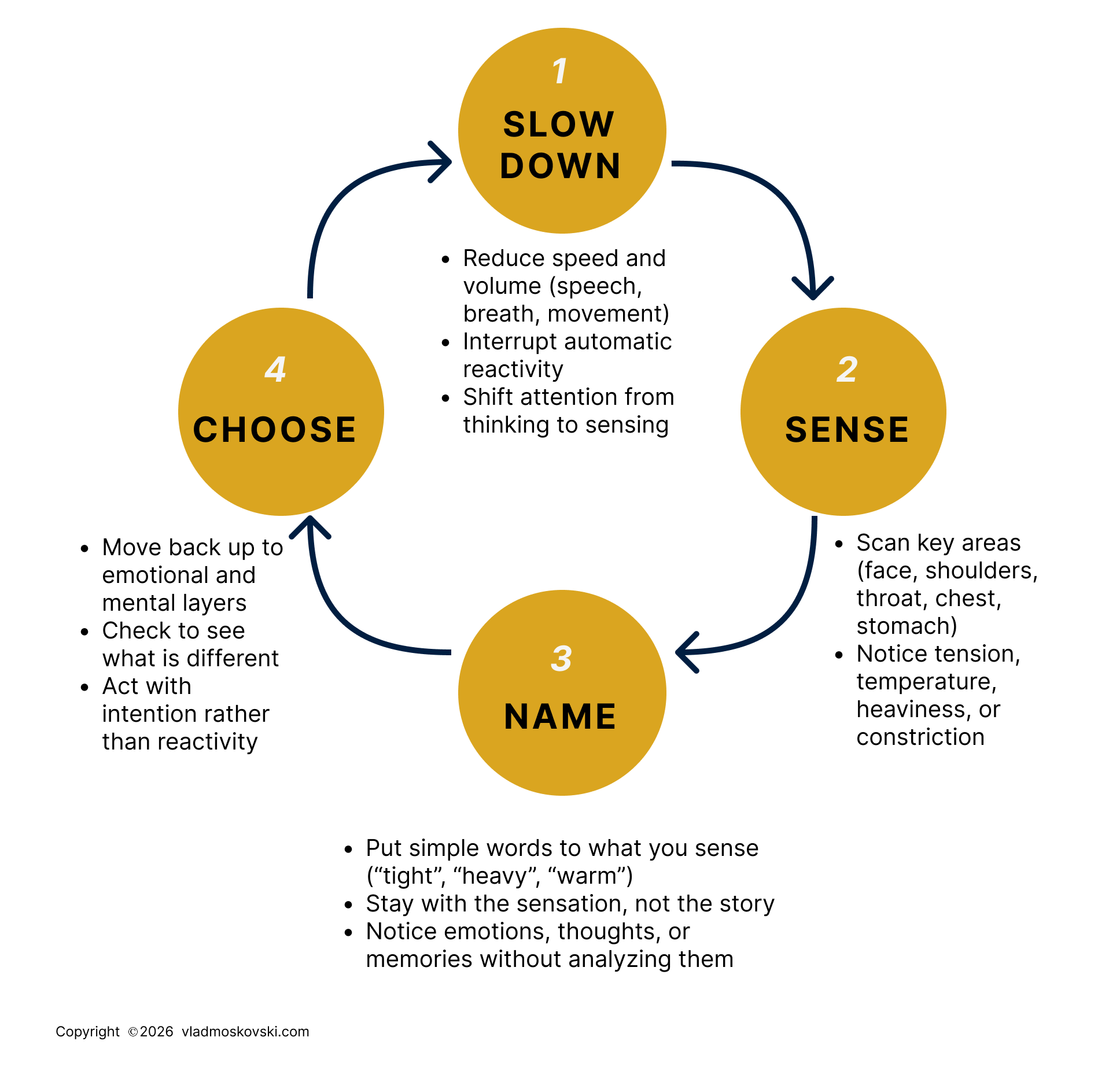
In practice, nervous system savvy leadership follows a simple wheel that has four steps.
First, leaders notice that they are experiencing tension, urgency, withdrawal, reactivity, or overwhelm. They need to slow down, reducing their speech, breath, and movement to interrupt automatic reactivity and shift their attention from thinking to sensing what's happening internally.
Second, focusing the attention inward, they scan 5 key areas for tension, temperature changes, heaviness, constriction, or any other sensations. The key areas are:
Face
Shoulders
Throat
Chest
Stomach
Third, they need to use the labeling part of their brain to engage cognition and put simple words such as "tightness," "heaviness," or "warmth." They need to stay with the sensations, not the story behind, while noticing thoughts, emotions, or memories without analyzing or engaging in them.
Step number four is to move the attention back into the emotional self to notice any differences in emotions or check to see what's different in terms of perspective or thinking.
Over time, leaders become faster at recognizing when pressure is driving behavior and more skilled at restoring capacity before it derails decisions or relationships.
What This Means for HR and L&D
If leadership capacity collapses under pressure, leadership development must be designed for pressure, not just for ideal conditions.
Manager training must include regulation skills and a basic understanding of how the nervous system works, as well as how to read signs when somebody’s cognitive abilities are hijacked and are not functioning. Somatic practices are most effective when taught experientially through workshops, simulations, and real-time application rather than as abstract concepts.
When leaders learn to work with their own system, they also become better at stabilizing their teams, reducing unnecessary conflict, and restoring trust during moments of stress and change. Leadership today is not failing because managers do not care, lack the skills or strategy, or are not working hard enough. It is failing because we have asked people to perform cognitively in environments that overwhelm their capacity, and since the pace of disruption is ever-increasing, the nervous system can not keep up.
Somatic intelligence offers a practical, research-informed way forward. It treats leadership and human performance as a dual system, where the cognitive is built on the foundation of somatic awareness and regulation.
For HR and L&D leaders, the question is no longer whether pressure affects performance. The question is whether leadership development will finally be designed to meet leaders where performance actually breaks down.