You can’t think your way out of stress. Under pressure somatic intelligence restores capacity
Why thinking harder doesn’t work under stress. A somatic intelligence framework for restoring clarity, capacity, and decision-making under pressure.
Imagine for a moment the following scenario: you are sitting in your office working on a project deadline when a Slack ping draws your attention. At the same time, your phone beeps with an important text message. Someone in your family needs you urgently. You suddenly remember you need to stop at the store for dinner, and at this very moment, a coworker walks by and gives you a strange look that reminds you of a previous conflict you thought was resolved.
Can you relate?
This is not an uncommon scenario. It is the everyday chaos of competing commitments, fractured attention, and a constant need to prioritize. Under pressure, with too many choices, we lose our capacity to stay present, think clearly, and act deliberately.
When we try to restore that capacity using logic or decision-making alone, it rarely works. You cannot think your way out of stress.
The Limits of Thinking Our Way Out
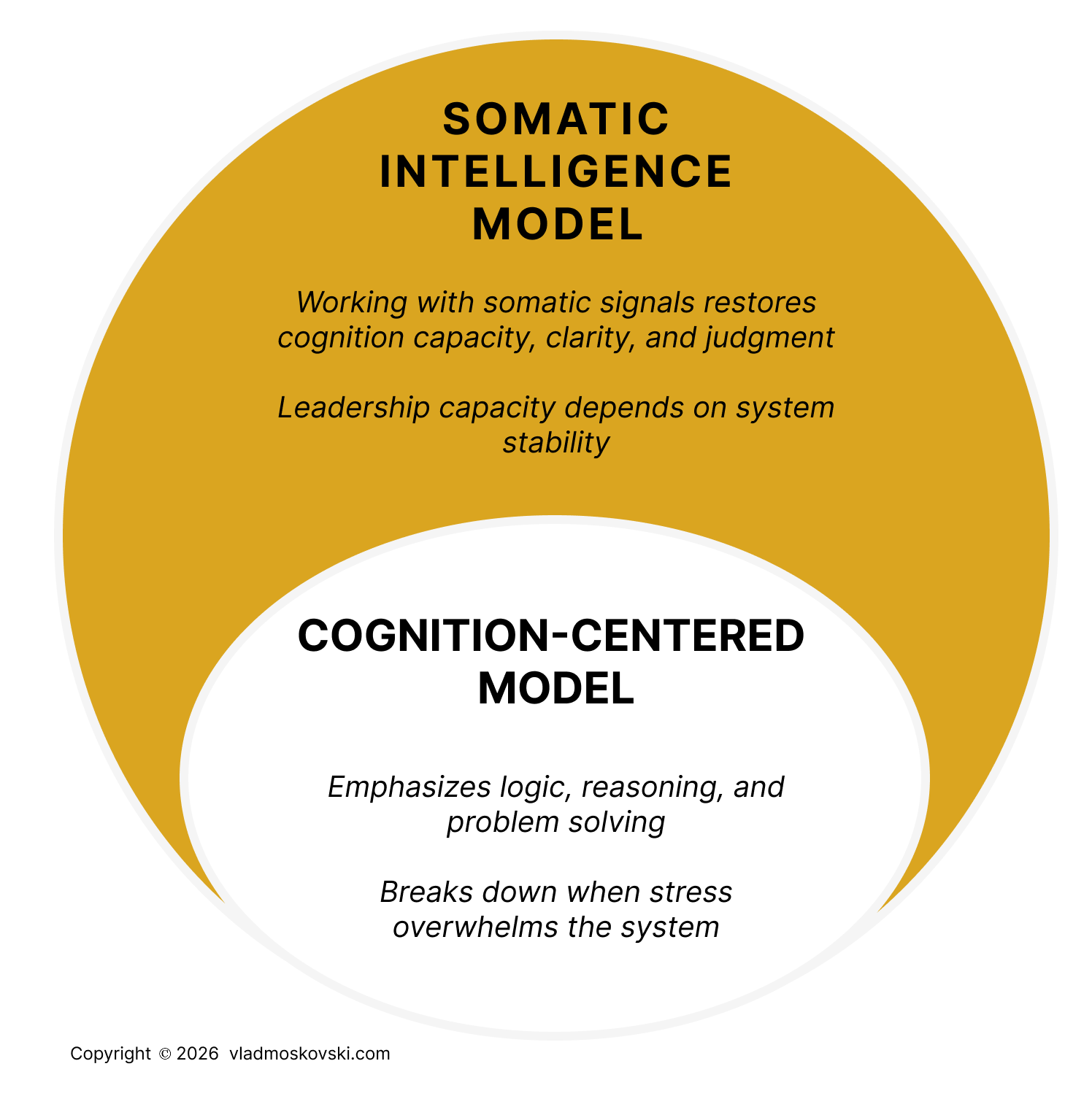
Our world operates within a cognition-centered model. This model assumes that logic, reasoning, and problem-solving are the primary drivers of success. These qualities of thinking get us through school, into universities, into well-paying jobs, and into positions of power and influence.
The core assumption is that clear thinking leads to good decisions. Under pressure, we need to think harder, decide better, or apply the right framework. In this model, the body is largely reduced to a transportation and nutrition system for the brain. Its role is to carry our big and important brain around.
This model works until it does not.
Under high levels of pressure:
Our capacity for clear thinking, memory, attention, and problem-solving degrades
Emotional urgency distorts judgment, and minor irritations become disproportionate. We become impatient, or worse.
In extreme cases, the system becomes overloaded and unable to restore equilibrium. We call this burnout, a mental health crisis, or a nervous breakdown.
What we are facing is not a lack of tools. It is a flawed underlying model. I believe this is one of the reasons anxiety, overwhelm, and mental health disorders continue to rise year after year. No amount of best intentions, beach vacations, or meditation apps has meaningfully slowed this trend. There are not enough therapists and coaches in the world to address it at scale.
A Larger Model: Somatic Intelligence
It is time to bring in a larger frame that can include the cognitive mode, rather than replace it. I call this the Somatic Intelligence Model.
This model starts from a different assumption: capacity depends on the stability of the whole system. That system includes not only thought and emotion, but also the nervous system and the five senses.
The body is continuously tracking signals of safety and threat. When we learn to work skillfully with the somatic signals the body sends to the brain, capacity can be restored. When capacity returns, mental clarity of judgment follows.
The Three Layers of Awareness
If these nested models are valid, the practical question becomes how we can work with them together as a unified system.
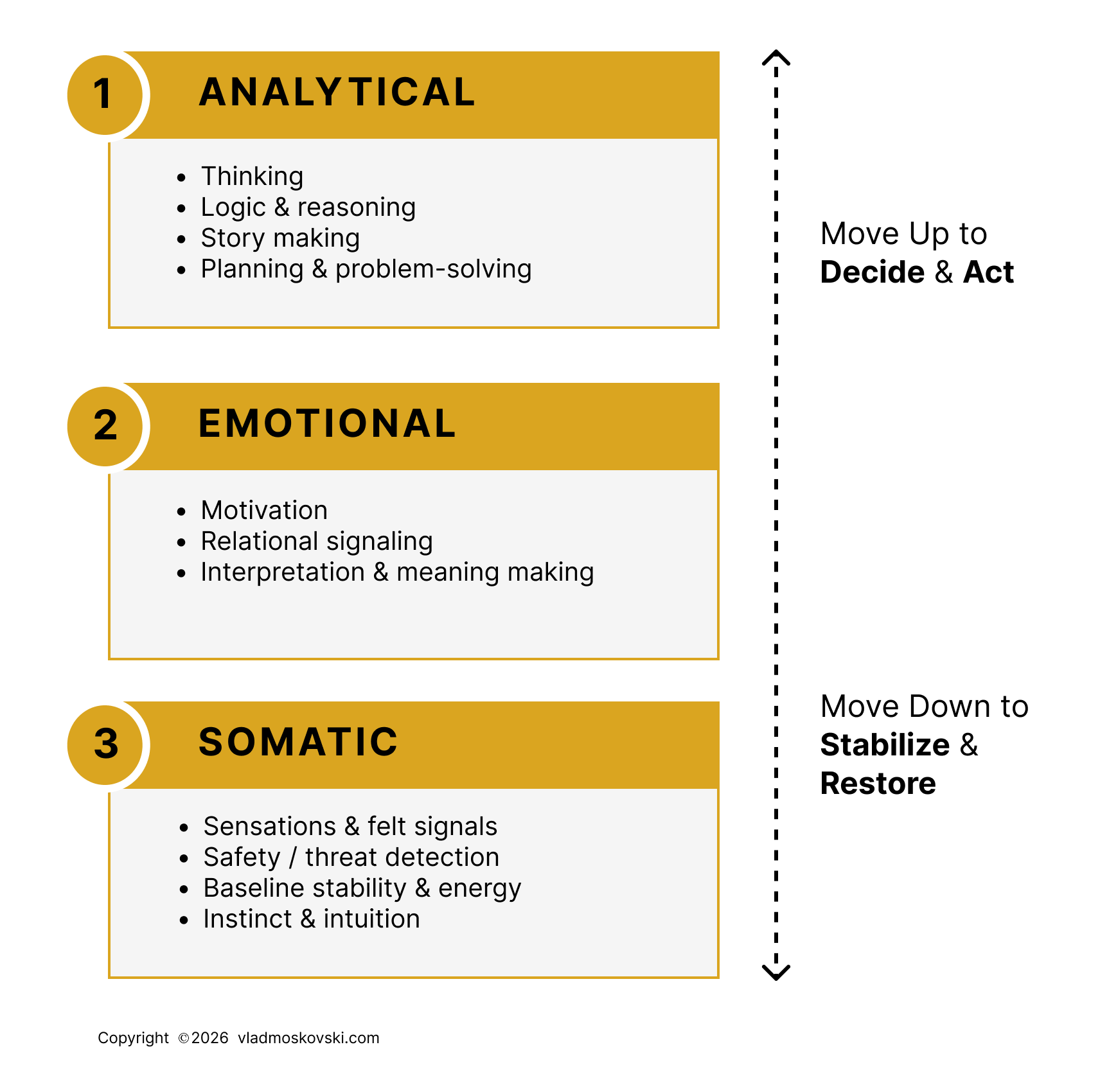
To do this, we must develop the ability to move fluidly between The Three Layers of Awareness: analytical, emotional, and somatic.
Layer 1 is the analytical. This is where we do our thinking, planning, and reasoning. The analytical layer is fast and readily available.
Layer 2 is the emotional layer. It is deeper, and often slower if we are not used to accessing it. This layer allows us to notice when we are having an emotional response that we may not be fully aware of, yet which may still be affecting us. Naming and feeling emotions allows us to understand our needs, which in turn shape motivation and how we relate to people and situations.
Layer 3 is the somatic layer, made up of the senses, the building blocks of the nervous system. This is the deepest, and often quietest, layer. We experience it as warmth, heaviness, pain, constriction, tingling, and other bodily sensations. Working at this level is the equivalent of opening your computer and tinkering with the CPU.
The reason many of us struggle to shift out of Layer 1 is that we are addicted to speed. Slowing down or shifting attention deeper often feels uncomfortable.
Imagine buying a car and being told it can only drive in fourth and fifth gear, with no access to first or second. That car would be ridiculously un-drivable. You would never buy it. And yet most of us live this way, unable to access the lower gears where the somatic layer resides.
The goal is not to live in one layer or another, but to develop the ability to move up and down between them with intention. With practice, we can learn how each layer functions and how to use them together for sustained performance and well-being.
Language of the Layers
If each layer could speak, this is how it would express itself:
Layer 1, the analytical, begins with “I think…”
Layer 2, the emotional, begins with “I feel…” It is important to distinguish feelings from interpretations. Words like sad or happy are feelings. Words like disrespected or judged are interpretations.
Layer 3, the somatic, begins with “I sense…” followed by sensation words and their location in the body, such as warmth in the chest, tightness in the shoulders, or tingling in the hands.
The Somatic Wheel Framework
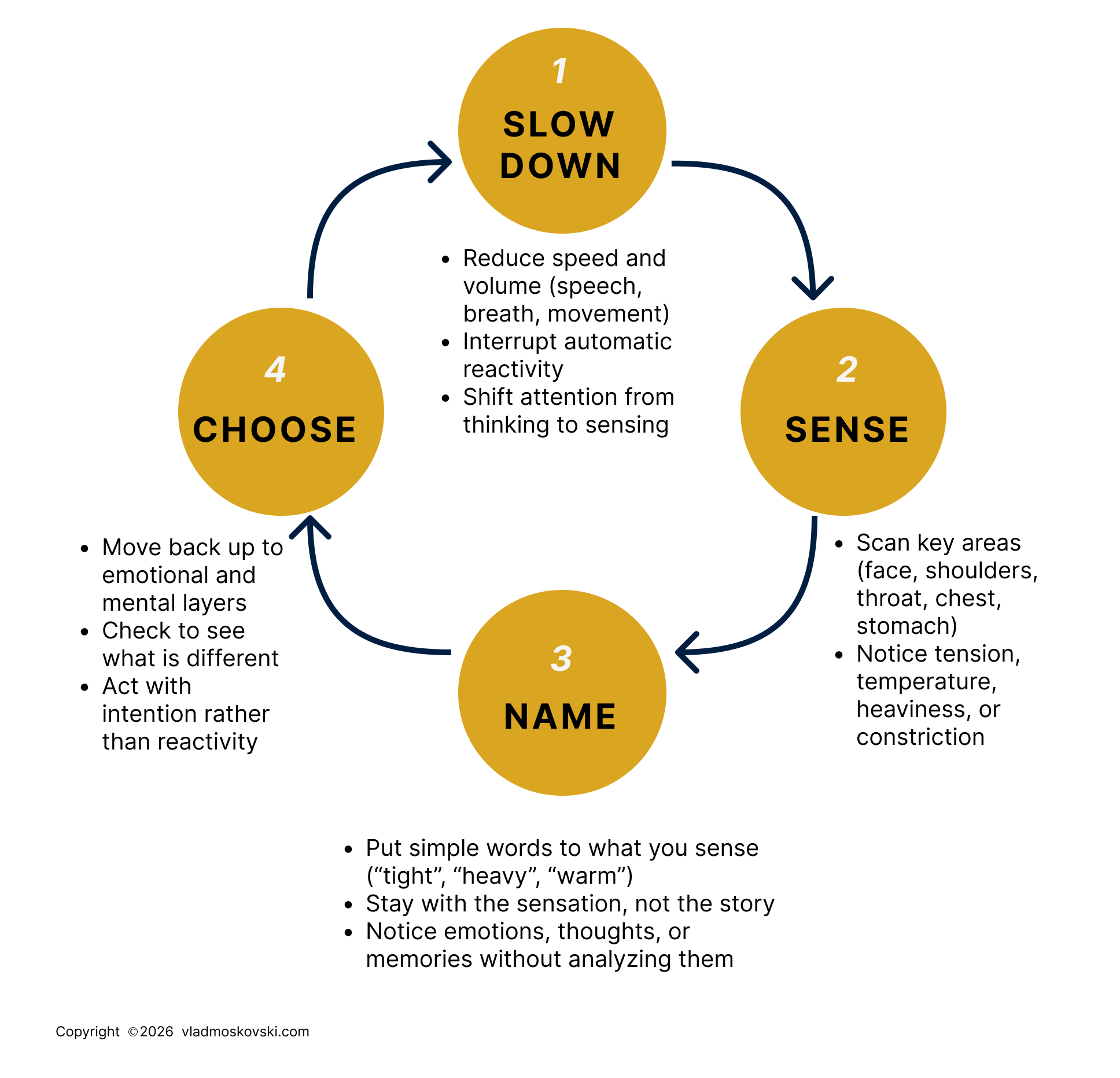
The most direct way to access the somatic layer is through a simple four-step protocol I call the Somatic Wheel.
This framework is designed to restore capacity before high-stakes conversations, during complex decisions, or when overwhelm has already taken hold. It functions both as a performance primer and as a way to build long-term resilience under pressure.
Step 1: Slow down.
The somatic layer operates at a slower speed. Think first gear. Reduce speech, volume, breathing rate, and body movement. Shift attention away from thinking and toward sensing.
Step 2: Sense.
Place attention, moment to moment, on one or more of the 5 Key Areas (to start with) where sensation is strongest. These areas are closely connected to the nervous system and major organs:
Face
Shoulders/Back
Throat
Chest
Stomach
Avoid evaluating or trying to change sensations. This pulls attention back into Layer 1.
Step 3: Name.
Silently or out loud, name the sensations you notice. Words like tightness, heaviness, constriction, warmth, or tingling. Stay with the sensation without creating a story or meaning.
If you find yourself analyzing or explaining, you have moved out of the somatic layer and back into the analytical one.
Remain with the sensations while noticing any emotions, thoughts, or memories that arise. After some time, move your attention back up to the emotional and analytical layers and get curious about what, if anything, has changed.
Step 4: Choose.
From this new state, revisit the decision, conversation, or situation.
If you approach this practice with the goal of immediate relief, it often disappoints. Curiosity works better. Over time and with practice, insight emerges from direct observation. Sensations arise and pass. From this impermanence, new ways of thinking and feeling often become available.
Common Pitfalls
Most people encounter some version of the following challenges:
Difficulty disengaging from analysis and slowing down
Brief access to sensation followed by rapid return to thinking
Expecting a result and moving too quickly out of sensing
Judging sensations or trying to explain them
Why This Matters Now
We are at an inflection point in our technological evolution. The tools designed to improve efficiency and quality of life now compete aggressively for attention, increasing stress and diminishing our capacity to focus and be present.
Learning to move between The Three Layers of Awareness and practicing somatic sensing allows a new way to meet the challenges of modern life with more choice and intentional presence. It expands our ability to perform under pressure and, over time, builds resilience in the face of intensity, uncertainty, and constant demand.
A well-regulated nervous system not only benefits the individual. It shapes how we show up in relationships, teams, and communities. It turns out that calm, grounded presence is felt by everyone around us, and so is its absence.
Somatic intelligence is not a luxury. It is a prerequisite.
Why Nervous-System-Savvy Managers Excel Under Pressure
Most leadership development assumes better thinking leads to better decisions. But under pressure, it is the nervous system, not cognition, that determines how leaders show up. Nervous-system-savvy managers build somatic intelligence and nervous system regulation skills, creating the foundation for clear decision-making, trust, and resilient leadership in high-pressure organizations.
Christine had been avoiding giving feedback to her younger team member, Nancy, for weeks.
She had intercepted negative feedback from a client about Nancy’s work and knew, logically, that addressing it was essential for Nancy’s growth and the team’s success. Yet every time Christine considered initiating the conversation, her stomach tightened, and her jaw clenched. So she delayed. Again.
In the past, Christine would have ignored these sensations and pushed herself to “just have the conversation.” This time, she took a different approach. Instead of rehearsing talking points or forcing confidence, she brought her attention to the discomfort in her body. She noticed the knot in her stomach. The tension in her jaw. She stayed with those sensations without trying to fix or analyze them.
After a few minutes, the tightness began to soften. Her breathing slowed. Her body settled. And suddenly, clarity returned. Christine knew exactly how to frame the feedback. Firm, honest, and supportive.
The next afternoon, she and Nancy had a productive conversation that strengthened trust rather than eroding it. This is the power of somatic intelligence, creating change by working with the body’s signals rather than relying on prolonged mental analysis or willpower alone.
The Real Problem: Leadership Capacity Under Pressure
Most organizations train managers to “communicate better,” or “delegate efficiently,” yet continue to see overwhelm, conflict, and burnout. Why? Because you can’t think your way out of stress, you have to sense your way out. Leadership rarely breaks down because people lack insight, intelligence, or skill. It breaks down because pressure overwhelms capacity.
Leadership capacity is the ability to stay present, think clearly, and act deliberately. Under pressure, that capacity degrades. No amount of cognitive reframing or communication skill training can reliably compensate when the fundamental nervous system is overloaded.
This is not a mindset problem. It is a systems problem.
You Can’t Think Your Way Out of Stress
Under pressure, the human system can quickly become overwhelmed and go into a state of activation. As urgency rises, attention narrows. Emotions amplify meaning, and threats are amplified. The strategic and locigal brain becomes hijacked. Externally, this can look like avoidance, procrastination, reactivity, and overwhelm.
In these states, asking leaders to “communicate better,” “stay calm,” or “be strategic” is not only ineffective. It is misaligned with how human performance and the nervous system actually works. This is why capable, well-intentioned managers avoid difficult conversations, escalate conflict unnecessarily, freeze during decisions, or default to reactivity or over-control. The issue is a lack of access.
Somatic intelligence is the ability to notice and work with the body’s signals, thus granting an individual access to unhijack their own brain.
Rather than treating bodily sensations as noise or distraction, somatic intelligence treats them as early information about capacity, safety, and readiness. When leaders learn to work with these signals, the nervous system stabilizes. Cognitive clarity returns. Judgment and greater/better choices become available.
Somatic intelligence does not replace thinking. It restores the conditions and builds the capacity to function under pressure. This is why Christine did not need a new script or framework. Once her system settled, the right words emerged naturally.
From Insight to Practice: The Somatic Wheel Framework
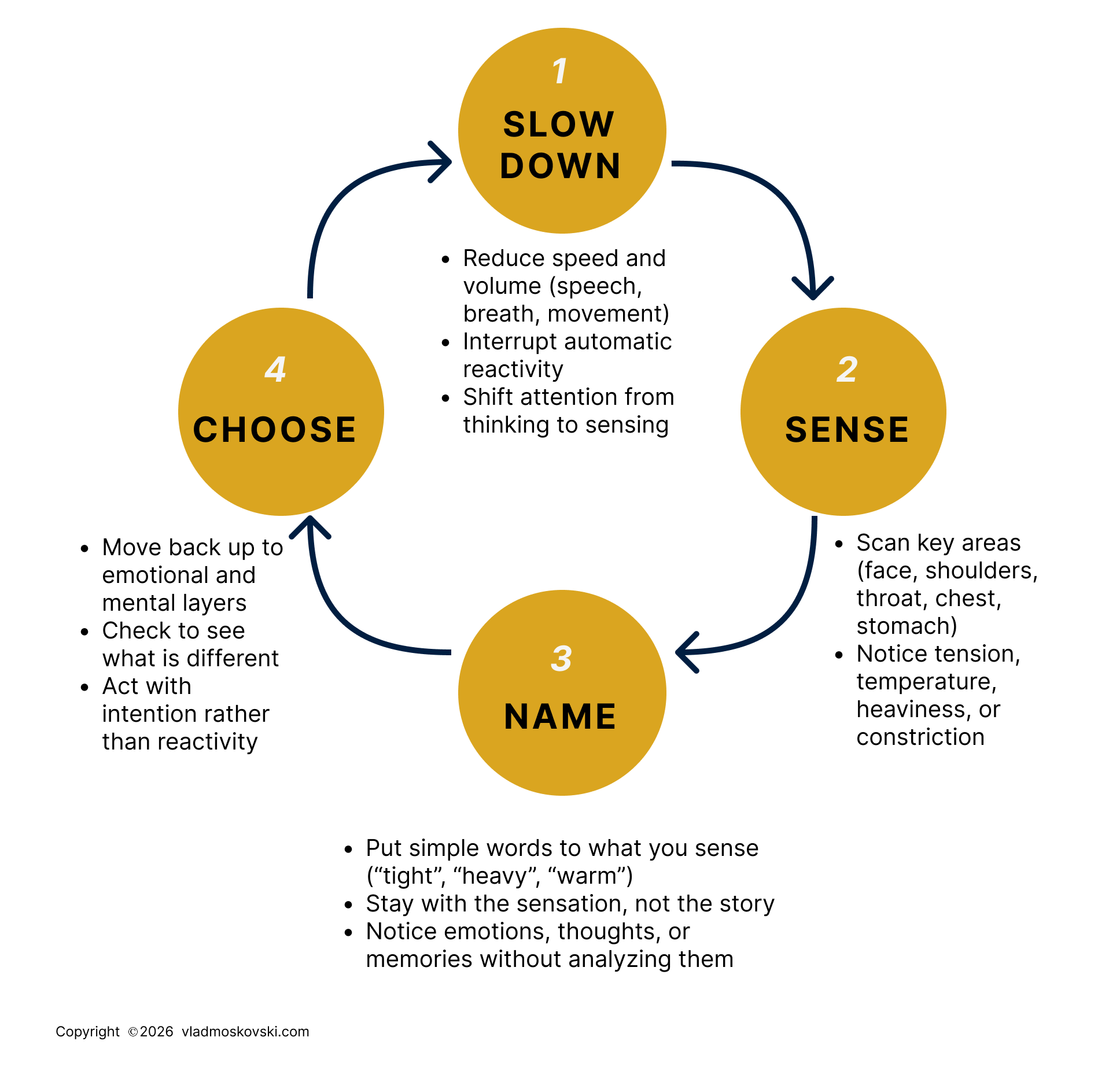
In practice, nervous system savvy leadership follows a simple wheel that has four steps.
First, leaders notice that they are experiencing tension, urgency, withdrawal, reactivity, or overwhelm. They need to slow down, reducing their speech, breath, and movement to interrupt automatic reactivity and shift their attention from thinking to sensing what's happening internally.
Second, focusing the attention inward, they scan 5 key areas for tension, temperature changes, heaviness, constriction, or any other sensations. The key areas are:
Face
Shoulders
Throat
Chest
Stomach
Third, they need to use the labeling part of their brain to engage cognition and put simple words such as "tightness," "heaviness," or "warmth." They need to stay with the sensations, not the story behind, while noticing thoughts, emotions, or memories without analyzing or engaging in them.
Step number four is to move the attention back into the emotional self to notice any differences in emotions or check to see what's different in terms of perspective or thinking.
Over time, leaders become faster at recognizing when pressure is driving behavior and more skilled at restoring capacity before it derails decisions or relationships.
What This Means for HR and L&D
If leadership capacity collapses under pressure, leadership development must be designed for pressure, not just for ideal conditions.
Manager training must include regulation skills and a basic understanding of how the nervous system works, as well as how to read signs when somebody’s cognitive abilities are hijacked and are not functioning. Somatic practices are most effective when taught experientially through workshops, simulations, and real-time application rather than as abstract concepts.
When leaders learn to work with their own system, they also become better at stabilizing their teams, reducing unnecessary conflict, and restoring trust during moments of stress and change. Leadership today is not failing because managers do not care, lack the skills or strategy, or are not working hard enough. It is failing because we have asked people to perform cognitively in environments that overwhelm their capacity, and since the pace of disruption is ever-increasing, the nervous system can not keep up.
Somatic intelligence offers a practical, research-informed way forward. It treats leadership and human performance as a dual system, where the cognitive is built on the foundation of somatic awareness and regulation.
For HR and L&D leaders, the question is no longer whether pressure affects performance. The question is whether leadership development will finally be designed to meet leaders where performance actually breaks down.